

IMPROvISATION

Improvisation is a way of meeting the moment as it unfolds.
Long before it was named, people were already working this way
— responding, adapting, and making things happen in real time.
Improvisation is less a style or a genre than a way of working:
being attentive, using what’s there, and choosing how to respond.

At some point, we came up with a name for this way of doing things: improvisation.
That’s a long word for a practice that happens instantly.
So, naturally, it was shortened.
And in that shorthand, something interesting began to happen.
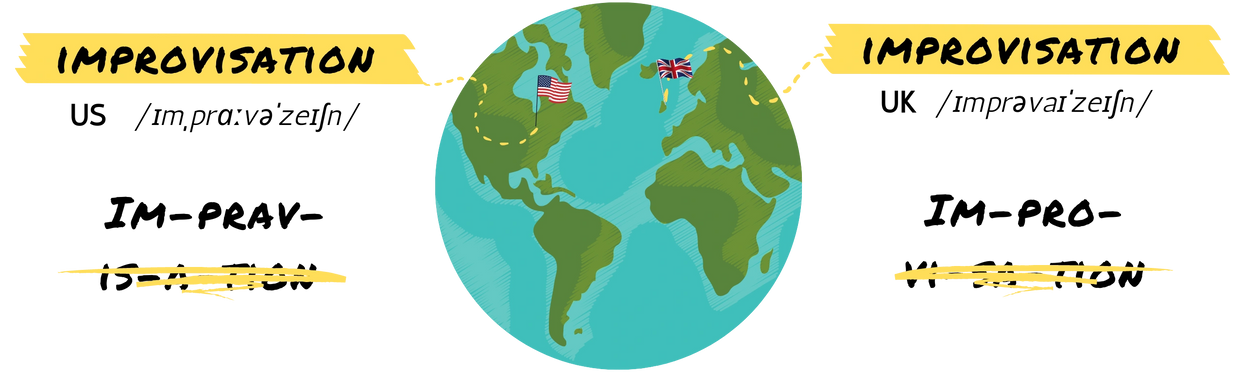
“Improv” and “impro” both emerged as abbreviations of improvisation.
In American usage, the emphasis falls on the v, giving rise to improv.
In British usage, the emphasis falls earlier, giving rise to impro.
Same word.
Same instinct.
Different cultures.
Within theatre, these differences became particularly visible.
Different practitioners, working in different places, began to develop distinct approaches to improvisation
— shaped by their social contexts, their artistic aims, and the audiences they were working with.

In Chicago during the 1940s and 50s, Viola Spolin was developing improvisational approaches to theatre through games. Working as a drama supervisor with the Chicago Works Progress Administration Recreational Project, she created exercises that treated improvisation as playful, accessible, and learnable — particularly for children. Her work, later gathered in Improvisation for the Theatre (1963), strongly influenced the improvised comedy scene that emerged in Chicago. Through her students and collaborators, improvisation moved into ensemble comedy and sketch, achieving widespread visibility through television and film and shaping how improv came to be understood as a comedic art-form in its own right.
Around the same time in the UK, Keith Johnstone was developing a different relationship to improvisation. Beginning his career as a schoolteacher, he became interested in how fear, status, and authority shape behaviour. This led him to explore improvisation not as preparation for performance, but as theatre itself — audience-facing, narrative, and alive in the moment. These ideas were articulated in Impro (1979) and later given practical form through TheatreSports™, which emerged in the late 1970s as a structured format for improvised theatre. Johnstone’s work has since influenced improvised theatre internationally, shaping training practices, performance formats, and pedagogical approaches across a wide range of contexts.

As ideas travelled, improv and impro came to be used interchangeably.
At Grand Stretch, we use improv as a shorthand for improvisation,
and to describe the North American performance style most widely recognised in Ireland.
We use impro to describe our approach — the theatre practices and show formats shaped by Keith Johnstone’s work.
Improvisation doesn’t belong to a single art-form.
Across music, dance, live art, and collaborative making, people use improvisation to generate ideas,
test relationships, and stay responsive to what’s unfolding. Sometimes it leads to performance.
Sometimes it leads to composition, structure, or script. Sometimes it simply changes how people work together.
Improvisation is a shared practice, shaped by context, carried across disciplines, and continually re-made through use.
Explore how approach and apply our unique way of working — through play, making, and performance.
.png/:/cr=t:10.25%25,l:0%25,w:100%25,h:80.81%25/rs=w:1209,h:549,cg:true)